

Nemesia Growing Guide: Best Varieties for Pots, Deadheading Tips and How to Get a Second Flush

Complete UK nemesia growing guide: annual vs perennial types, planting, the mid-summer cut-back for a second flush, containers, fragrant varieties and more.
Nemesia’s reputation as a humble gap-filler at the front of the border seriously undersells it. For a few weeks in late spring, it can outflower almost everything else at its scale — then, if you know the one technique that makes the difference, it does it all again in late summer. It’s fragrant (some varieties smell of vanilla, others of coconut). It offers one of the widest colour ranges of any bedding plant, including some of the most genuinely blue flowers available to UK gardeners. And it asks for surprisingly little: sun, drainage, and one well-timed mid-summer haircut.
What trips most gardeners up is not the care — it’s the confusion between the annual and perennial types. The nemesia sold as plug plants from your local nursery is not the same plant as the seed packet on the rack next to it, and treating them identically is the main reason nemesia sometimes disappoints. This guide starts there, then works through everything you need to grow it well in the UK climate.
Annual or Perennial? Understanding the Different Types
Nemesia is a genus of around 65 species native to southern Africa, but UK gardeners will only ever encounter a handful. Understanding the distinction between them is more practically useful than most plant labels suggest.
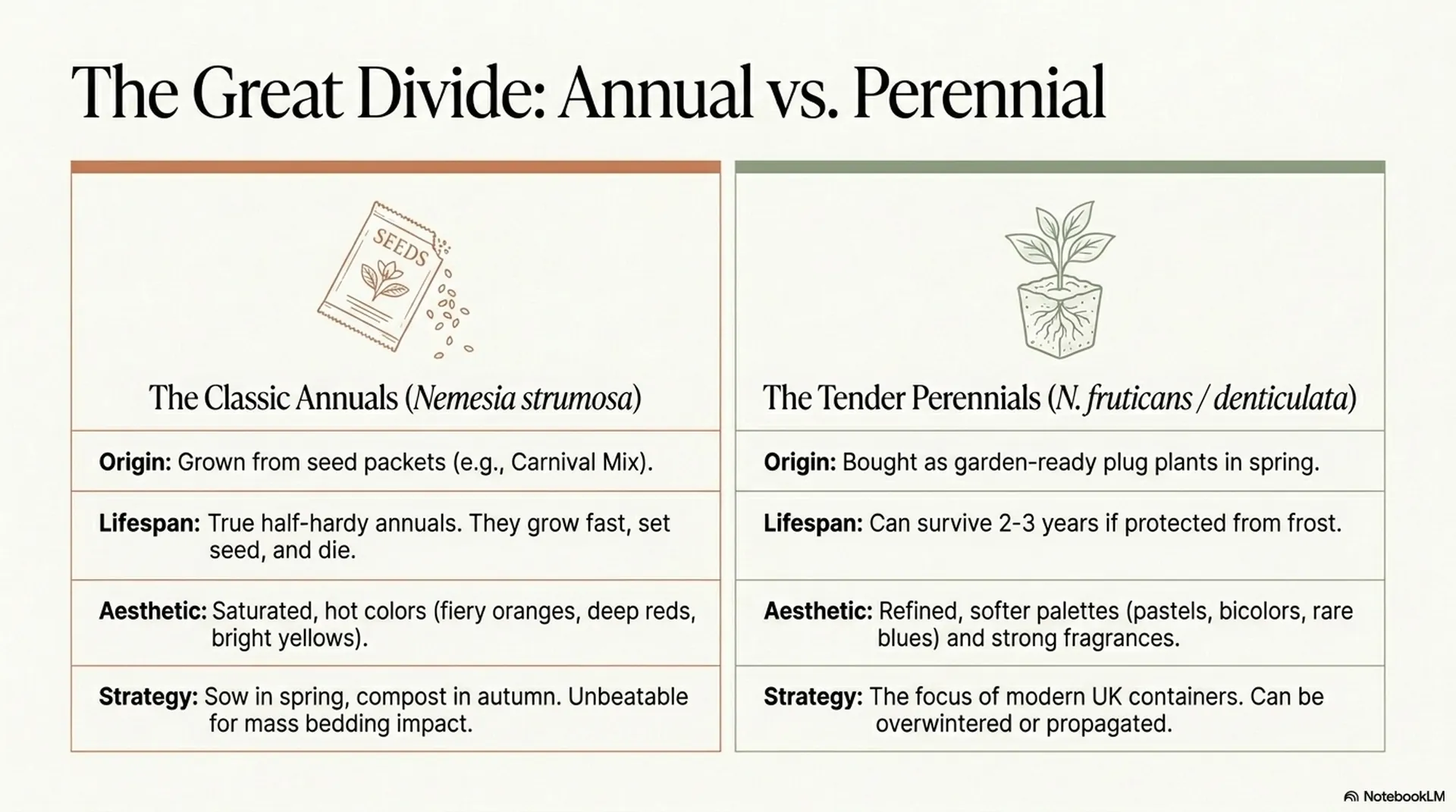
Nemesia strumosa (Cape jewels) is the classic annual nemesia. It grows fast, flowers intensely over several weeks, sets seed, and dies. Most seed packets — Carnival Mix, Prince of Orange, Red and White — belong here. These are true half-hardy annuals: sow in spring, plant out after the last frost, enjoy the display, and compost the plants in autumn. They’re brilliant value, easy from seed, and produce the most vivid hot colours in the range — saturated oranges, deep reds, and bright yellows [1].

Three pre-planned garden beds, free
Stop staring at empty beds: printable plans with exact layouts, plant lists and planting calendars — yours free from the Garden Library.
Nemesia caerulea, N. denticulata and N. fruticans are the tender perennial species, and it’s from these — particularly fruticans and denticulata — that most modern named varieties are bred. The Sunsatia series, Aromance series, and named cultivars like ‘Wisley Vanilla’ and ‘Berries and Cream’ are hybrids with tender perennial genes. They can technically survive for two or three years if protected from frost, though (more on that in the overwintering section) this requires specific conditions and doesn’t always succeed. N. denticulata holds the RHS Award of Garden Merit, recognition of its reliable performance in UK garden conditions [2].
The practical implication for shoppers: if you’re buying plug plants or garden-ready plants in spring — by far the most common way nemesia is sold — you’re almost certainly buying a tender perennial hybrid. These offer a more refined, longer display and include the most interesting colour combinations and fragrant varieties. If you’re growing from seed, you’re probably working with N. strumosa annual types. Both are worth growing, but they suit slightly different purposes.
UK Climate Suitability: Hardiness and the Frost Window
Nemesia carries an RHS hardiness rating of H3 — half-hardy, tolerant of temperatures down to around -5°C but unable to survive a true freeze [1]. In practical terms for UK gardeners: plant outdoors only after the last frost has passed.

In most of England and Wales, the safe planting window opens in mid-May. In Scotland and exposed northern areas, late May or early June is more reliable. Coastal gardens in the southwest — where spring frosts are rare — can get away with planting a few weeks earlier. The RHS advises waiting until late spring or even early summer before planting outdoors [1].
The H3 rating also works in your favour: nemesia performs best in mild, bright conditions rather than intense heat. Our cool UK summers, which cause so many heat-loving plants to sulk, suit nemesia almost perfectly. It’s one of those plants that was practically designed for British weather.
How to Grow Nemesia from Seed
Growing nemesia from seed is worth the effort if you want the classic annual types in bulk — filling long bedding schemes, cutting patches, or window boxes on a budget. For smaller quantities of specific named varieties, plug plants are more practical.
Timing: Sow indoors in February or March. Don’t sow too early — February sowings need a heated propagator; March on a bright, moderately warm windowsill works fine for most homes [5].
Method: Fill seed trays or small modules with fine seed compost and firm lightly. Scatter seeds thinly across the surface — nemesia seeds are small but manageable — and cover with a 2–3mm layer of fine vermiculite. Enclose in a propagator or cover with a clear plastic bag and place somewhere warm at 15–20°C. Germination takes 7–14 days at this temperature [5].
Growing on: Once seedlings are through, remove the cover and move to a cooler, very bright spot. Nemesia seedlings become leggy if kept warm — a cold greenhouse or cool windowsill at around 10°C is ideal. Prick out into individual 7.5cm pots when large enough to handle. Feed with a half-strength liquid fertiliser fortnightly as they grow.
Hardening off: Don’t skip this step. Move plants outdoors for increasing periods over 7–10 days before planting out — nemesia is easy to raise from seed but doesn’t forgive a sudden cold shock from being moved straight outside.
For a later, simpler sowing, you can direct-sow into prepared beds in May or early June, though results are less predictable and the display starts later in the season.
Planting Nemesia: Site, Soil and Spacing
Nemesia is not demanding, but there are two conditions it genuinely won’t compromise on.
Sun: Full sun is ideal for the best flowering. Nemesia will tolerate light, dappled shade — particularly welcome shelter from the hottest afternoon sun in an unusually warm UK summer — but deep shade noticeably reduces flower production [1]. A south-, east- or west-facing aspect works well; north-facing positions rarely produce a strong display.
Drainage: Non-negotiable. Wet or waterlogged soil causes foot and root rots that can kill plants within days [9]. South African in origin, nemesia evolved in free-draining, sandy soils. On heavy clay, either work in plenty of horticultural grit before planting or grow in containers where you control the compost mix entirely.
Stop missing your zone's planting windows.
Select your US zone and month — get a complete checklist of what to plant, prune, feed, and protect right now.
→ View My Garden CalendarSoil pH: A slight preference for mildly acidic to neutral soil (broadly pH 6.0–7.0) [4]. Most UK garden soils fall within this range without amendment.
Spacing: Plant compact bushy varieties 15–20cm apart; the more spreading perennial types, particularly N. denticulata, benefit from slightly wider spacing up to 25cm [6]. Closer spacing fills in quickly for an immediate lush display; wider spacing gives plants room to develop their natural habit fully.
Planting technique: Firm in gently, water well at planting, and if conditions are bright and sunny, give new transplants a few days’ protection from full midday sun while they establish. They settle in quickly and need very little fussing after the first week.
Watering and Feeding
Consistent moisture is the single most important care factor for nemesia. They want the soil or compost to stay evenly moist — not waterlogged, not parched. In warm weather, drying out causes flower production to slow noticeably and can trigger bud drop. Nemesia growing in containers is particularly vulnerable; a pot sitting in a saucer of water will rot the roots, but so will allowing the compost to dry out completely between waterings [5].
Water regularly during dry spells. Terracotta containers dry out much faster than plastic ones — check them daily in warm, breezy conditions [6].
For feeding, start with a balanced liquid fertiliser in late spring to support early establishment and leaf growth. Once the plant is in full flower — or once you’ve done the mid-summer cut-back described below — switch to a high-potash liquid feed (tomato fertiliser works perfectly) applied every two weeks. High potash specifically supports flower production; it’s the same reason we feed flowering plants like sweet peas and fuchsias with potash-rich fertilisers rather than general balanced feeds [5].
Deadheading and the Mid-Summer Cut-Back
Regular deadheading is worthwhile: removing spent flowers prevents the plant putting energy into seed production and encourages fresh buds to form. With nemesia, this takes only a few minutes — snip or pinch off individual faded blooms as they go over.

But the most practically useful piece of nemesia care advice — and the one most first-season growers don’t know — is the mid-summer cut-back.
By late June or early July, most nemesia will have produced a generous initial flowering flush, then become progressively straggly: leggy stems, sparse new flowers, and a generally tired appearance. Left alone, this is more or less how they continue until autumn. The solution is decisive: cut the entire plant back by roughly half, using shears or sharp scissors [6]. Not just nipping the tips — a proper haircut, taking the plant back to about its midsection.
After cutting, water generously and apply a high-potash liquid feed. Within two to three weeks, fresh growth pushes up from the base. By August or early September, the plant is flowering again — often as strongly as it was in May.
I understand the hesitation: cutting back a plant that still has a handful of flowers on it feels counterproductive. It isn’t. The tired, woody growth won’t produce a sustained late-summer display, and the new growth it stimulates gives you a genuinely fresh flowering cycle rather than a dribble of late blooms. Use the shears, feed afterwards, and be patient for a fortnight.
This technique works best for the perennial hybrid types. Annual N. strumosa varieties can also be cut back, though they regenerate with less vigour [7]. The RHS confirms this approach as the standard recommended method for promoting continued flowering [1].
If your nemesia is showing more serious signs of stress beyond mid-season fatigue — yellowing leaves, grey-purple fuzz on foliage, or flowers disappearing entirely — see the full troubleshooting guide: Nemesia Problems: Leggy Growth, Mildew and Fading Flowers.
Growing Nemesia in Containers, Hanging Baskets and Window Boxes
Containers are where nemesia particularly earns its keep in the UK garden. Its compact, bushy or semi-trailing habit, prolonged flowering with proper care, and wide colour range make it one of the best bedding choices for pots, window boxes, and hanging baskets.

Use a peat-free multi-purpose compost mixed with around 20–25% perlite or vermiculite to ensure sharp drainage [1]. Poor drainage in a container is the most common reason nemesia underperforms — even if the planting position looks right, soggy compost sitting around the roots invites the root rots that are nemesia’s main weakness.
Raise containers off hard surfaces using pot feet or bricks so water can escape freely from drainage holes. Check compost moisture daily in warm weather; containers dry out far faster than open ground.
Feed every two weeks with a high-potash liquid fertiliser from the moment active flowering begins [5].
Hanging baskets: The semi-trailing Sunsatia varieties — Sunsatia Cranberry, Sunsatia Lemon, Sunsatia Blood Orange — work beautifully, spilling softly over the sides while more upright varieties fill the centre zone [8].
Window boxes: The compact Poetry Mix is an excellent choice, forming a dense carpet of soft pastel colours at 20–25cm height. Pair with trailing lobelia to carry colour over the front edge.
Mixed planters: Combine nemesia with calibrachoa for continuous small-flowered colour across the season, or with verbena at the back for added height variation.
Colour Range: Fiery Oranges, Soft Pastels and the Rare Blue
One of nemesia’s greatest strengths is its colour breadth. The seed-grown annual types — Carnival Mix, N. strumosa selections — deliver a hot, vibrant range: intense oranges, deep reds, bright yellows, and pure white, often in bi-colour combinations with contrasting throats. These are unmatched for impact in massed bedding schemes.
Modern hybrid varieties add an entirely different register: softer peach, cream, coral, lilac, and mauve. Bi-colour varieties like ‘Rhubarb and Custard’ (purple and yellow) and ‘Berries and Cream’ (purple, mauve, and white) are among the most requested by UK gardeners looking for sophisticated container plantings rather than a traditional bedding scheme.
But nemesia’s most distinctive colour offering is genuine blue — and this is worth pausing on. True blue flowers are extraordinarily rare in the bedding plant world. Most ‘blue’ lobelia and ‘blue’ petunias are violet-purple on close inspection rather than genuinely blue. Varieties like ‘Fleurie Blue’ and Karoo Soft Blue produce flowers with clear, authentic blue tones — soft mid-blue with white or cream centres [9]. This makes them uniquely valuable if you’re working with a specific colour scheme: matching blue painted furniture, complementing silver foliage, or building a cool-toned white-and-blue planting combination that avoids the all-too-common slide into purple.
Fragrant Varieties: Which Nemesia Smell Best?
Nemesia fragrance is significantly underrated — and also unevenly distributed. Not all varieties carry scent, and even within the scented types, the character of the fragrance varies. Here’s a practical guide to the main fragrant series available in the UK.
Aromance series (Nemesia fruticans hybrids): Strongly and sweetly scented with a fruity, warm character. ‘Aromance Pink’, ‘Aromance Mulberry’, and ‘Aromance White’ are the main UK-available selections. The fragrance is most perceptible in warm, still air — on a calm sunny morning, it carries clearly from a container on the patio [4].
Nemesia ‘Wisley Vanilla’: The most distinctly named scent in the range — a clear, identifiable vanilla fragrance from white flowers with a yellow eye [3]. Available as a named tender perennial variety, it responds well to the overwintering cutting technique described below and is worth preserving year to year specifically for this fragrance.
Poetry Mix: A seed-grown annual blend in soft pastel shades — purple, pink, blue, and white — described as delicately fragrant. Available from Unwins and Marshalls Garden. Less intense than the Aromance series but easy to raise from seed and an honest-value choice for mixed plantings.
Scentsatia series: Specifically bred for fragrance, with varieties noted for a coconut-like scent. ‘Scentsatia White’ and ‘Scentsatia Cherry’ are the most widely stocked in the UK [7].
Nemesia cheiranthus ‘Shooting Stars’: An unusual annual type bearing yellow flowers on long spurs with a distinctive coconut fragrance [5]. More curious than conventionally pretty, it’s worth growing if you like plants with character.
If fragrance is your primary goal, Aromance Pink or ‘Wisley Vanilla’ are the two to seek out. If you want fragrance combined with long flowering from plug plants, Aromance is the easier find in garden centres from April onwards.
Companion Plants for Nemesia
Nemesia’s compact scale, long flowering season, and wide colour range make it a highly versatile mixer in containers and border edges. These pairings work particularly well.
Lobelia: The traditional UK pairing, and still one of the best. Blue or white trailing lobelia spills over the edges of a container while nemesia fills the centre with upright colour. They share identical care requirements — moist compost, sun to part shade — making co-planting straightforward. The contrast between lobelia’s fine, trailing texture and nemesia’s bushy habit gives the combination genuine structure.
Calibrachoa (Million Bells): A modern update on the classic pairing. Calibrachoa and nemesia operate at the same scale and have very similar care needs. A container of warm-toned coral nemesia with peach or apricot calibrachoa produces a sophisticated, long-season display from May through September with minimal intervention.
Verbena: Adds height variation and an airier texture. Purple verbena planted behind blue nemesia produces a cool-toned scheme that works particularly well in grey or terracotta pots. Both benefit from deadheading and potash feeding on the same schedule.
Petunias: The classic high-coverage mixed container combination. Choose compact petunia varieties to avoid overwhelming the nemesia — surfinia and trailing types can outcompete smaller plants in the same container.
Diascia and Osteospermum: Specifically recommended by the RHS as seasonal container companions for nemesia [1]. Diascia’s delicate, spurred flowers echo the scale of nemesia perfectly; osteospermum’s bolder daisy form provides a contrasting focal element.
One pairing to avoid: nemesia in the same container as drought-tolerant plants like lavender, pelargoniums, or succulents. Their watering regimes are incompatible — what nemesia needs to keep flowering will quickly cause root problems for drought-tolerant companions.
Overwintering Tender Perennial Nemesia
If you’ve grown a named perennial hybrid variety — ‘Wisley Vanilla’, ‘Aromance Pink’, ‘Berries and Cream’, ‘Fleurie Blue’ — overwintering it saves money and preserves a specific variety you’ve grown attached to. But be realistic about the approach: whole-plant overwintering has a meaningful failure rate, and fresh cuttings are a more reliable insurance policy.

Annual types (N. strumosa and seed-grown varieties): Don’t attempt to overwinter these. They are true annuals. Simply sow fresh seed each February or March.
Option 1: Overwinter the whole plant
Before the first frost — typically October across most of England — cut the plant back hard by roughly half to two-thirds and move it into a frost-free but cool environment: an unheated greenhouse that stays above 3–5°C overnight, a cool porch, or a cold conservatory works [5].
Water minimally throughout winter — just enough to prevent the compost drying out completely. Wet compost in cold conditions causes root rot, which is the most common cause of winter losses. Avoid warmth: anything above 10°C triggers soft, leggy growth that performs poorly once it goes back outside. The target is dormancy at around 5°C, not active growth [7].
In late February or March, move to a brighter, slightly warmer position to restart growth. Cut back any remaining straggly stems, begin watering more regularly, and apply a balanced liquid fertiliser every two weeks. Harden off carefully before planting out after the last frost.
Option 2: September cuttings (recommended)
In September, take 7–10cm softwood cuttings from the tips of non-flowering shoots. Strip the lower leaves, leaving just two or three at the tip, dip the cut end in hormone rooting powder, and insert into a 50:50 mix of perlite and compost in small pots [5].
Keep in a frost-free environment — even a bright windowsill in a cool room — and water sparingly. Cuttings root reliably in four to six weeks. By February, young rooted cuttings can be potted into fresh compost and grown on for a May planting.
September cuttings root more reliably than trying to keep parent plants alive over winter, and the insurance logic is sound: if the cuttings take and the parent dies (entirely possible), you haven’t lost the variety. If both survive, you have more plants for free. Either way, you win.
Best Nemesia Varieties: A UK Selection
| Variety | Type | Colour | Fragrance | Height | Best for |
|---|---|---|---|---|---|
| Sunsatia Cranberry | Tender perennial hybrid | Deep red-pink | None | 20–30cm | Hanging baskets, containers |
| Sunsatia Lemon | Tender perennial hybrid | Pale yellow | None | 20–30cm | Mixed planters, baskets |
| ‘Wisley Vanilla’ | Tender perennial | White with yellow eye | Strong vanilla | 20–40cm | Fragrance, containers |
| Aromance Pink | Tender perennial hybrid | Soft pink | Sweet, fruity | 20–30cm | Fragrance, patio pots |
| ‘Fleurie Blue’ | Tender perennial | True blue/white centre | None | 20–40cm | Colour schemes, containers |
| Poetry Mix | Annual (seed) | Pastel mix: pink, purple, blue, white | Delicate | 20–25cm | Seed sowing, window boxes |
| Carnival Mix | Annual (seed) | Hot mix: orange, red, yellow, white | None | 20–30cm | Bedding, bold colour schemes |
| N. denticulata (AGM) | Tender perennial species | Light purple | None | 10–50cm | Borders, naturalised planting |
| ‘Berries and Cream’ | Tender perennial hybrid | Purple, mauve, white | None | 20–30cm | Sophisticated mixed containers |
| Scentsatia Cherry | Tender perennial hybrid | Cherry red | Coconut | 20–30cm | Fragrance, containers |
Frequently Asked Questions
Is nemesia a perennial or annual?
Both — it depends on the type. Nemesia strumosa and most seed-grown varieties are half-hardy annuals that complete their lifecycle in one season. Named plug-plant varieties like ‘Wisley Vanilla’, the Sunsatia series and Aromance series are tender perennial hybrids that can survive multiple seasons if overwintered frost-free. In the UK, both types are treated as seasonal bedding and replaced or overwintered annually.
Why has my nemesia stopped flowering in summer?
This is normal — nemesia typically produces a strong initial flush in late spring and early summer, then becomes leggy and flowers sparsely by July. The solution is the mid-summer cut-back: shear the whole plant down by roughly half, water well, and apply a high-potash feed. New growth and a second flush of flowers follows within two to three weeks.
Can nemesia grow in shade?
It tolerates light, dappled shade but flowers significantly less freely in shade than in full sun. For best results, choose a position with at least five or six hours of direct sunlight daily. North-facing positions and deep shade are not suitable.
Is nemesia toxic to dogs, cats or children?
Nemesia is not toxic to humans or pets [7]. It can be planted freely in gardens shared with dogs, cats, or small children without concern.
Can I grow nemesia in a hanging basket?
Yes — the semi-trailing varieties (particularly the Sunsatia range) are among the best performing plants for mixed hanging baskets. Use free-draining compost mixed with perlite, water daily in warm weather, and feed fortnightly with a high-potash liquid fertiliser once flowering begins.
When should I plant nemesia in the UK?
Plant outdoors after all risk of frost has passed — typically mid-May in most of England and Wales, late May to early June in Scotland and exposed northern areas. Starting from seed indoors, sow in February or March at 15–20°C.

Sources
- RHS — Nemesia plant guide
- RHS — Nemesia denticulata (AGM)
- RHS — Nemesia ‘Wisley Vanilla’
- RHS — Nemesia Aroma series (fragrance, soil, care notes)
- BBC Gardeners’ World — How to Grow Nemesia
- Sarah Raven — How to Plant and Grow Nemesias
- Plantura UK — Nemesia: Location, Overwintering and Toxicity
- RHS — Nemesia Sunsatia series
- RHS — Nemesia ‘Fleurie Blue’
For the best plants to grow alongside nemesia in containers, hanging baskets, and border edges, see our guide to nemesia companion plants — ten cool-season partners that share nemesia’s South African origins and spring-and-fall growing window, with a full pairing table and practical design combinations.


