Lavender Meaning: Why Romans Paid 50 Denarii Per Pound — and What Devotion Looks Like in Bloom

Discover what lavender truly symbolises — from devotion and serenity to the surprising Victorian meaning of distrust — across history, culture, and spiritual tradition.
Lavender is one of those rare plants whose meaning and scent arrive together. Breathe it in and something in you slows down — the shoulders drop, the mind clears. It’s been doing that for people for over two thousand years. Yet there’s a twist in lavender’s symbolic history that almost no one talks about: in the Victorian language of flowers, this herb of calm and devotion also carried the meaning of distrust.
That contradiction is worth unpacking. It tells you something important — not just about lavender, but about how plants accumulate meaning across centuries, picking up new associations without entirely shedding the old ones. This guide covers all of it: the classical roots, the cultural layers, the spiritual traditions, and the social subtlety behind that Victorian distrust. For the full context of flower symbolism, see our flower symbolism guide.
What Does Lavender Symbolise?
At its core, lavender is the flower of devotion, calmness, serenity, and purity. The purple-blue spike has represented constancy and quiet faithfulness for centuries — the kind of love that doesn’t shout, but endures. In the modern language of flowers it’s used to say: I am here, steadily, without drama.
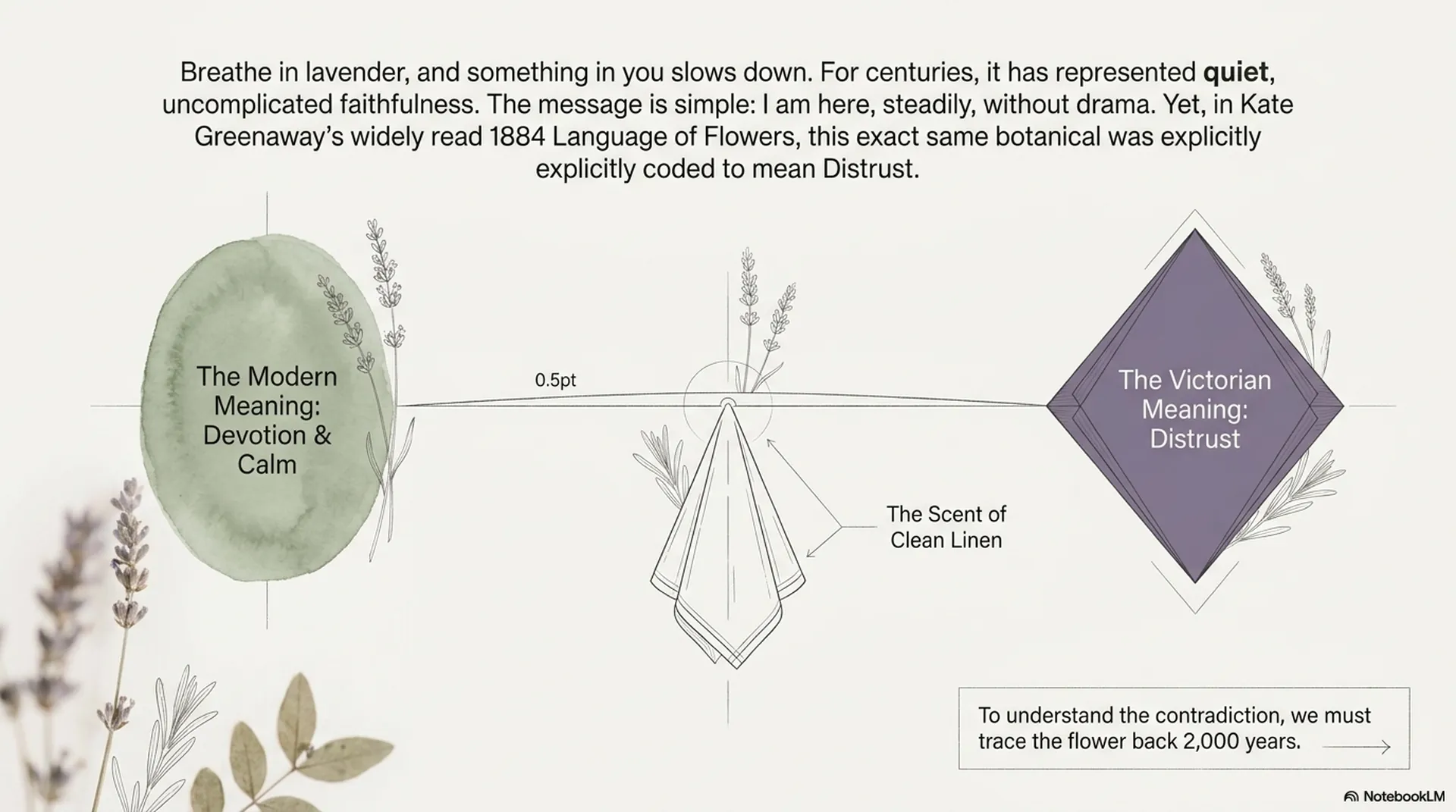
Secondary meanings include grace, refinement, and silence. There’s a quality to lavender’s symbolism that sits between action and stillness — it doesn’t bloom in a blaze like a rose or a peony. It comes back reliably every summer, fills the air, and asks nothing. That’s where its association with faithful, uncomplicated devotion comes from.

Get a free pre-planned flower bed (vase-worthy from June to frost)
Printable planting plans for a cut-flower bed and a cottage pollinator bed — plant list, spacing, and calendar included.
But the picture isn’t entirely soft. In the Victorian tussie-mussie tradition — where bouquet composition was a coded language with its own grammar — lavender carried an additional, sharper meaning: distrust. That requires some explanation.
The Victorian Distrust Angle
Victorian flower language was codified in texts like Kate Greenaway’s Language of Flowers (1884) and a dozen similar volumes circulating in middle- and upper-class households. Each flower in the vocabulary carried a specific message that could be sent silently, through a carefully arranged posy, without a word ever being spoken. [3]
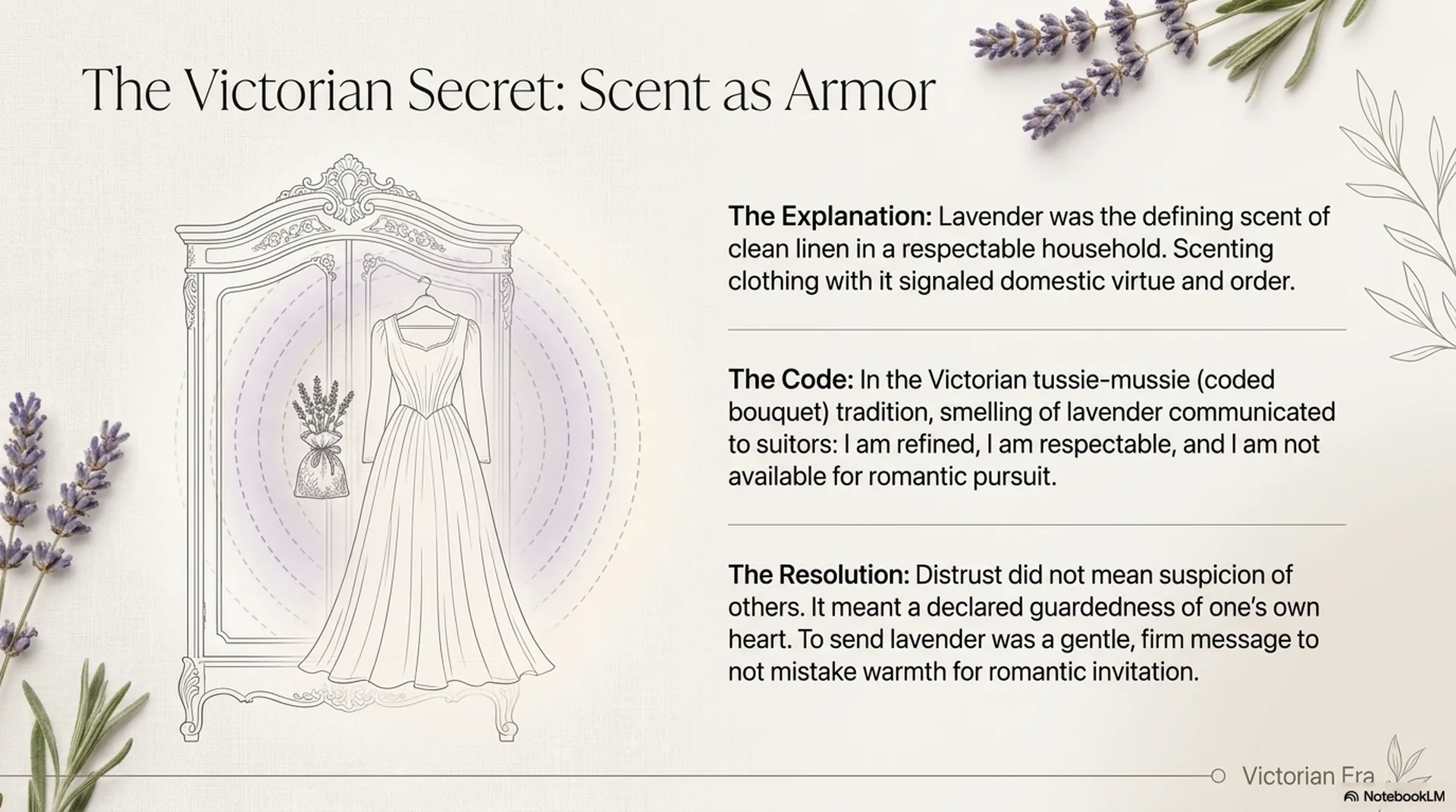
Lavender’s assigned meaning — distrust — seems at first to contradict everything else the plant stood for. It isn’t contradictory once you understand the social mechanism behind it.
Lavender was the defining scent of clean linen in the Victorian household. Women of good standing tucked dried lavender sachets into wardrobes, drawers, and clothing chests. To wear garments fragrant with lavender was to signal domestic virtue — you were orderly, capable, and well-kept. The scent was, in a sense, armour. A woman who went into a social gathering smelling of lavender was communicating something that would have been immediately legible to contemporaries: I am refined, I am respectable, and I am not available for romantic pursuit.
In this context, distrust doesn’t mean suspicion of someone else. It means a declared guardedness of one’s own heart. The lavender-scented woman was said to be protected from unwanted advances — not by force, but by the social grammar of the scent itself. Suitors understood the signal. To send someone lavender in a tussie-mussie was, therefore, a gentle but firm message: do not mistake my warmth for romantic invitation.
This is the layer of lavender’s meaning that no other flower meaning article develops. It reframes distrust not as hostility but as self-possession — which is entirely consistent with lavender’s broader character.
Lavender Meaning Across Cultures
Lavender’s cultural biography spans at least two millennia, and each era has added a distinct symbolic layer.
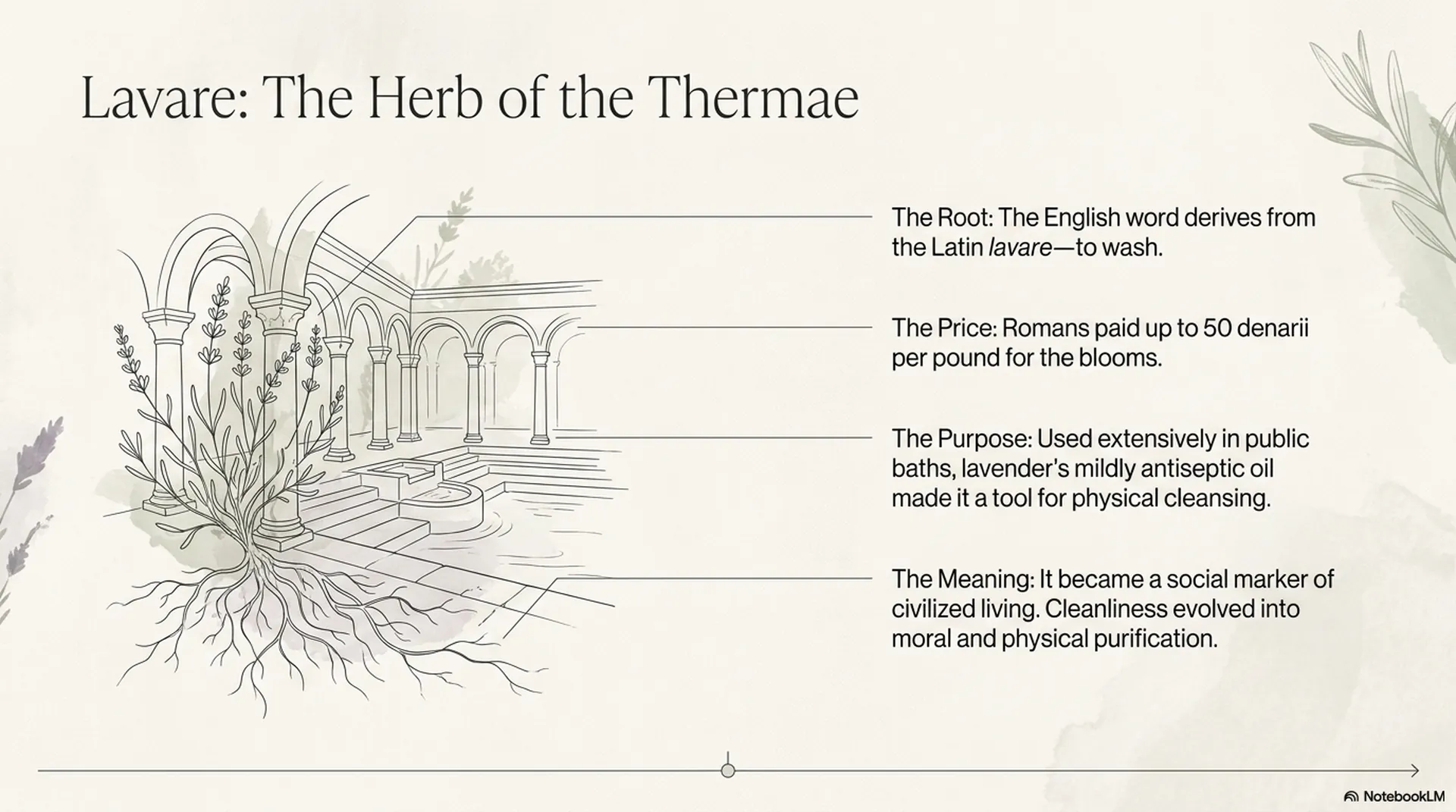
Roman: The Herb of the Thermae
The English word “lavender” derives, via Old French lavandre, from the Latin lavare — meaning to wash. [1] The plant became synonymous with bathing in the Roman world, where it was one of the principal herbs used in the thermae, the great public baths that were a centrepiece of Roman social life. Adding lavender to bathwater was not merely practical (the oil is mildly antiseptic); it was an act of social participation, a marker of civilised living. Cleanliness and purification — moral as much as physical — were what lavender meant in Rome.
Medieval Christian: Mary’s Drying Plant
In medieval Christian Europe, lavender acquired a sacred association with the Virgin Mary. The plant was called “Mary’s drying plant” in the tradition: legend held that the Virgin dried the infant Jesus’s swaddling clothes over lavender bushes, and that this was how the herb received its distinctive scent and its association with spiritual purity.
The 12th-century abbess and herbalist Hildegard von Bingen included lavender in her Physica (c. 1150–1160), prescribing it for maintaining a “pure character” and for its clarifying effects on the mind. [2] For Hildegard, medicinal and spiritual properties were inseparable — a herb that cleared the eyes and composed the mind was also an aid to moral clarity. Lavender’s role as a herb of purity had, by this point, a theological dimension.
English Cottage Garden: Domestic Faithful Love
In the English tradition, lavender became one of the defining plants of the cottage garden — a garden style that valued simplicity, self-sufficiency, and old-fashioned domestic happiness. Growing lavender along a path or tucking it beside a front door was associated with a quiet, faithful kind of love: the love of a well-kept home, of constancy over novelty, of generations living in the same place. It’s an unsentimental symbolism, but it runs deep.
You might also find azalea meaning: symbolism, passion helpful here.
I’ve noticed this quality in my own garden: lavender at the gate seems to signal something to visitors before they’ve even reached the door — an intention of welcome, of something reliable behind it.
Provence, France: The Scent of a Region
The cultural identity of Provence is inseparable from lavender to a degree that few other flowers achieve anywhere in the world. The Comité Interprofessionnel des Huiles Essentielles Françaises (CIIFE), which governs fine lavender production, oversees an industry representing around 85% of French lavender output — almost entirely concentrated in Provence. [6]
Stop missing your zone's planting windows.
Select your US zone and month — get a complete checklist of what to plant, prune, feed, and protect right now.
→ View My Garden CalendarLavender here is not just a crop; it’s a visual and olfactory emblem of a way of life. The lavender fields in bloom across the Valensole plateau are the image that defines Provence for the world: heat, light, purple rows running to the horizon, the buzz of bees. In Provençal culture, lavender is associated with Mediterranean grace, the quality of summer light, and the good life as a tangible sensory reality — not an abstraction.
Lavender Meaning by Colour
Most lavender is purple, but the plant grows in white and pink forms too, and each carries its own nuance.
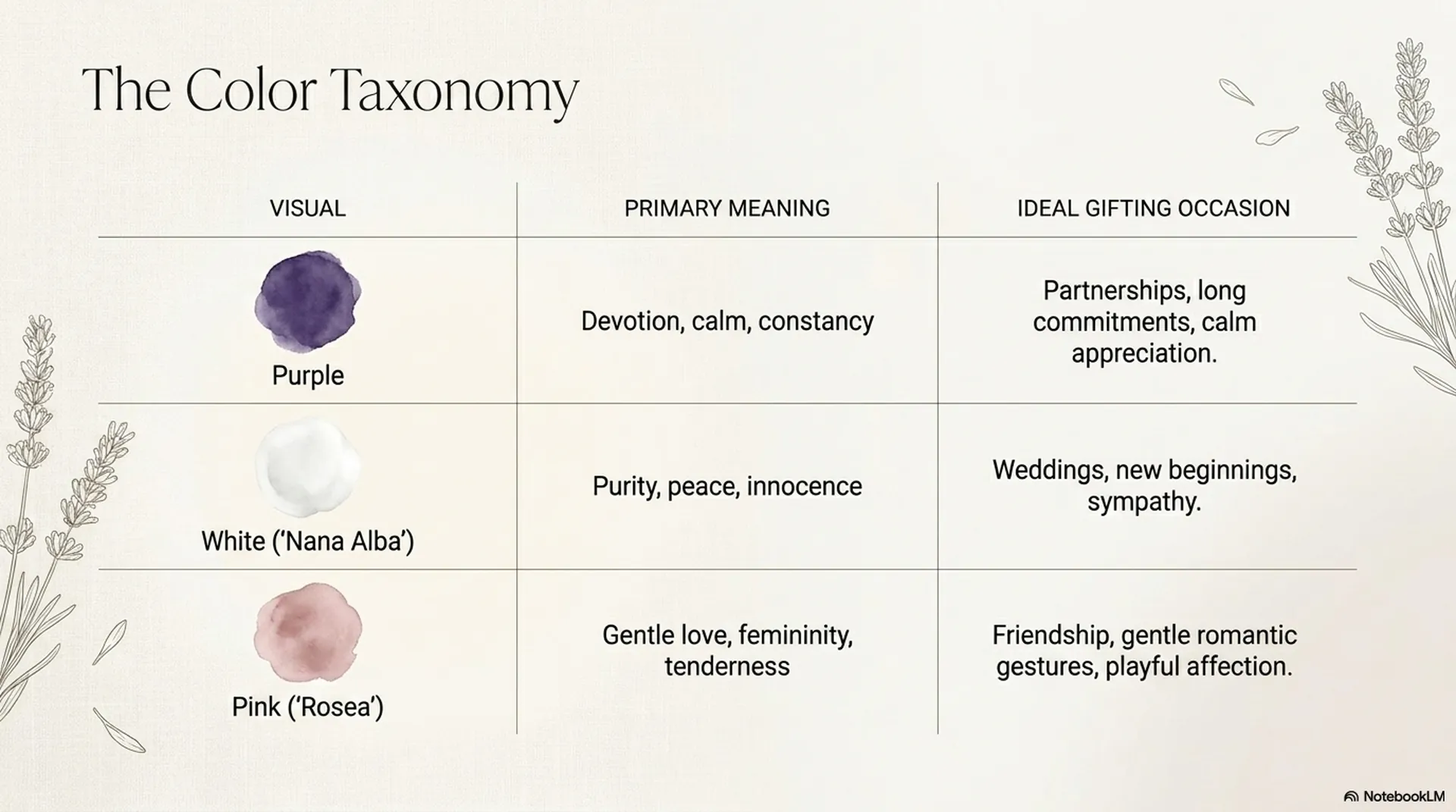
| Colour | Primary Meaning | Best For |
|---|---|---|
| Purple lavender | Devotion, calm, constancy | Partnerships, long commitments, calm appreciation |
| White lavender | Purity, peace, innocence | Weddings, new beginnings, sympathy |
| Pink lavender | Gentle love, femininity, tenderness | Friendship, gentle romantic gestures, new relationships |
White lavender (Lavandula angustifolia ‘Nana Alba’ and similar) is the least common in gardens but carries a particularly clean symbolic weight — purity without austerity. Pink varieties such as ‘Rosea’ soften the usual gravity of lavender’s symbolism into something more playful and affectionate. [5]
You might also find dahlia meaning: symbolism, inner strength helpful here.
What Does Lavender Mean as a Gift?
Lavender is one of the most semantically flexible gifts you can give, because its meanings are compatible across many kinds of relationship and occasion.

For someone going through stress or anxiety, lavender is perhaps the most apt flower choice you can make. The anxiolytic properties of linalool — lavender’s primary active compound — are clinically documented: one peer-reviewed study found lavender oil as effective as low-dose lorazepam for generalised anxiety. [4] The symbolic meaning (calm, serenity) and the physiological effect work in the same direction. A lavender bunch says: I want you to rest.
For meditation and wellness contexts, lavender is the natural choice among fragrant flowers. Its connection to the crown chakra in many spiritual traditions makes it specifically appropriate for practitioners, and a dried lavender bundle is both a practical and meaningful gift for anyone with a meditation practice.
As a wedding favour, lavender sachets represent devotion and constancy — both appropriate to the occasion. They’re also practical: guests take them home, and the meaning travels with them.
In dried bouquets, lavender has a distinct advantage over most flowers: it dries beautifully, retains its scent for months, and actually improves in some ways as it dries — the colour deepens to a warm dusty purple. A dried lavender bundle is a gift with unusual staying power, both practically and symbolically. Compare it to gardenia meaning and fragrant flower symbolism — gardenias are exquisite fresh but don’t dry well; lavender keeps giving.
You might also find lotus flower meaning: symbolism helpful here.
The Spiritual Meaning of Lavender
Lavender has one of the longest spiritual pedigrees of any herb in the Western tradition.

In angelic herbalism — a tradition drawing on medieval Christian herbalism and later esoteric practices — lavender is the herb most closely associated with Archangel Michael. Michael’s attributes are protection, clarity, and the cutting away of what is negative or false; lavender’s purifying and clarifying properties made it a natural symbol for his domain. Burning or using lavender in a space was understood as an act of protection and the clearing of negative energy.
Across multiple spiritual traditions, lavender is burned — as incense, as smudge, or dried in a fire — to promote healing visions and to clear the mind for divine communication. The mechanism here is consistent with Hildegard von Bingen’s 12th-century framing: the herb that composes and clarifies the mind is also the herb that makes space for the sacred. [2]
For prayer and meditation, lavender’s calming effect is both physiological and symbolic. The linalool in lavender oil has demonstrable effects on the nervous system [4] — it slows physiological arousal, reduces cortisol responses, and calms the mind’s threat-processing. Whether you approach lavender spiritually or not, the act of burning it or breathing its scent before meditation is supported by real neurochemistry. The spiritual traditions intuited something that the science later confirmed.
If you’d like to grow lavender at home and create your own supply of dried bundles, sachets, or fresh cuttings, see our complete lavender growing guide for everything from soil preparation to harvesting for fragrance.
Frequently Asked Questions
What does lavender symbolise spiritually?
Lavender represents purification, spiritual clarity, and protection. It’s associated with Archangel Michael in angelic herbalism and is used across spiritual traditions to clear negative energy, calm the mind before prayer or meditation, and promote healing. Its spiritual meaning traces directly to its physiological effect: linalool genuinely calms the nervous system, and this documented calming property has always underpinned lavender’s spiritual reputation. [4]
What does lavender mean in the language of flowers?
In the general language of flowers, lavender means devotion, calmness, serenity, and purity. In the specific Victorian tussie-mussie tradition, it carried the additional meaning of distrust — in the sense of a declared guardedness of one’s own heart rather than suspicion of others. [3]
Why does lavender mean distrust in Victorian flower language?
Because lavender was the defining scent of clean, well-kept Victorian linen. A woman who scented her clothing with lavender was signalling domestic virtue and social refinement — and, implicitly, that she was not romantically available. In the coded vocabulary of Victorian floriography, lavender therefore became a signal of self-protective guardedness: I am warmth and refinement, but not romantic invitation. Distrust in this context means the dignified withholding of the heart, not hostility.
Sources
- Etymology Online. “Lavender.” etymonline.com. Accessed March 2026.
- Hildegard von Bingen. Physica, c. 1150–1160. Book on simple medicine, lavender chapter. Primary medieval herbal source.
- Greenaway, Kate. Language of Flowers. London: George Routledge and Sons, 1884.
- Koulivand, P.H., Khaleghi Ghadiri, M., and Gorji, A. “Lavender and the Nervous System.” Evidence-Based Complementary and Alternative Medicine, 2013. PMC3612440.
- Royal Horticultural Society. “Lavandula.” rhs.org.uk. Accessed March 2026.
- Comité Interprofessionnel des Huiles Essentielles Françaises (CIIFE). Fine lavender production, Provence region.